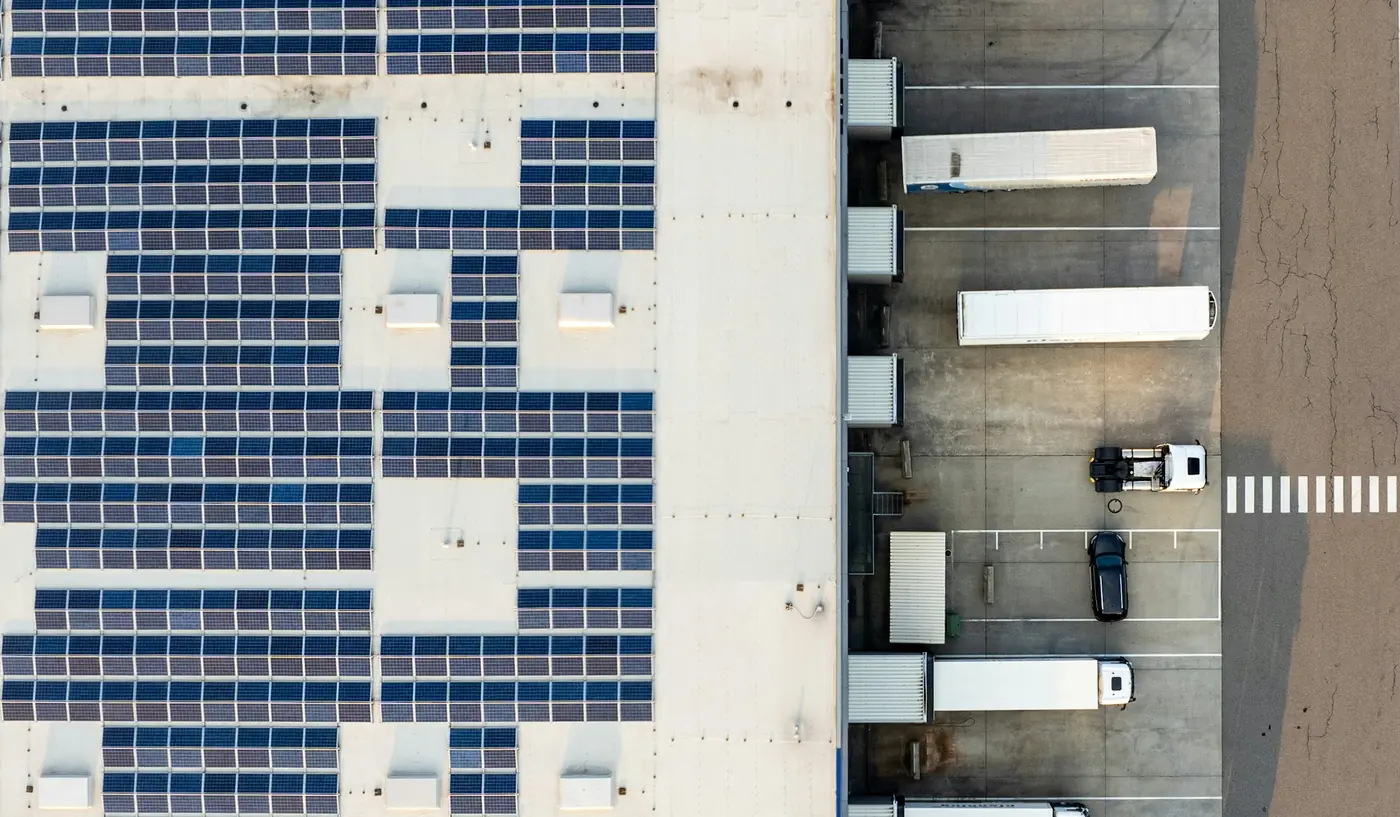
Solar, paid for by someone else.
A rooftop power purchase agreement (PPA) lets your business use solar power without buying the panels. Here's how it works, who does what, and when buying outright makes more sense.
The model, plainly.
Under a rooftop PPA, a specialist funder pays for the solar panels on your roof and owns them. You agree to buy the electricity they generate, usually for 15 to 25 years, at a price per kWh set below what you pay your energy supplier.
Your site uses solar power first. Whenever the panels aren't producing enough, at night, on dull days or at peak demand, your existing grid supply tops you up exactly as it does today. You only pay the funder for the solar electricity you use.
There's no capital outlay and no equipment for you to look after. The funder earns back its investment through the electricity you buy over the term of the agreement, which is why it looks after the system so carefully.
Who does what
You
Provide the roof and buy the solar electricity you use, at the agreed price.
The funding partner
Designs, pays for, installs, owns, monitors and maintains the system for the length of the agreement.
Vaux Solar
Finds and assesses suitable roofs, models the savings, introduces the right funder and helps steer the process through to switch-on.
Two routes to the same roof.
For many businesses the appeal is the saving without the capital spend. If you'd rather own the system, we can help with that too.
| Compare | Rooftop PPA | Buy outright |
|---|---|---|
| Upfront cost | £0 | The full cost of the system |
| Who owns the panels | The funder, for the length of the agreement | You, from day one |
| Maintenance and repairs | The funder | You, often through a maintenance contract |
| What you save | The difference between your grid price and the PPA price, on every kWh you use | The full grid price of every kWh you use, plus any payment for power you export |
| Commitment | An agreement, typically 15 to 25 years | None beyond the purchase |
| Tax | The electricity is a running cost of the business | May qualify for capital allowances. Ask your accountant. |
| Best for | Businesses that want lower bills without spending capital | Businesses with cash or finance available that want the largest long-term return |
Is your site a fit?
Funders look for the same handful of things. If you can tick most of these, it's worth a conversation.
- Roof sizeRoughly 750 m² or more of usable roof, enough for a system of about 150 kWp or larger.
- Daytime electricity useThe more of your power you use during daylight hours, the more of the solar you use yourself and the better the saving.
- Ownership or consentYou own the building, or your landlord agrees to the installation.
- An established businessA trading history and accounts, as funders are entering a long agreement with you.
- Little shadingFew trees or taller buildings shading the roof for much of the day.
- Roof conditionOlder roofs are fine to discuss. A replacement can often be included in the funding.
- Grid connectionWe check whether the local network can take the system. Larger systems may need approval from the network operator.
Not sure?
Send us what you have. The assessment is free, and if your site isn't right we'll tell you so.
Who owns the panels?
The funding partner owns the system for the length of the agreement. You keep ownership of your building and roof; the agreement gives the funder the right to keep the panels there and to access them for maintenance.
Who looks after maintenance?
The funder. Monitoring, inspections, cleaning and repairs are their responsibility, and they have every reason to keep the system working, because they're paid for the electricity it produces. You'll be asked to allow reasonable access to the roof.
What happens at the end of the agreement?
It depends on the agreement, but the usual options are to extend it, to buy the system, or to have it removed. Panels typically keep generating for years beyond a 25-year term. We'll walk you through the end-of-term options in your agreement before you sign.
What if we move premises?
Agreements normally plan for this. Commonly the agreement can pass to the building's next owner or occupier, or there's a buyout figure set out in advance. If a move is likely in the next few years, tell us at the start so it shapes the right structure.
Is the price fixed?
The price is agreed before anything is installed. Some agreements fix the rate for the whole term; others rise by a set percentage or in line with inflation each year. Either way, you'll see the numbers in full before you commit.
How long does it take?
Every site is different, but as a rough guide: a desk assessment of your roof comes first, followed by a site visit and a savings model. Funding approval, system design and grid connection approval from the local network operator usually take a few months, and grid approval is often the longest step. Installation on a typical commercial roof takes weeks rather than months.
What does the assessment cost?
Nothing. The roof assessment is free and doesn't commit you to anything.
What if our roof needs replacing?
Tell us early. A roof near the end of its life isn't a dealbreaker: a replacement can often be included in the funding, so the panels go onto a roof that will last the length of the agreement.
Find out what your roof could save.
The assessment is free and there's no obligation. If your site isn't a good fit, we'll tell you plainly.
Book a free roof assessment